How Per-Credit Pricing Degrades Your Lead Lists
Per-credit pricing models force GTM teams into a scarcity mindset, discouraging the exploration needed to build high-quality lead lists. We explain the second-order effects of this model and why a pricing structure is a core product feature.
The Scarcity Mindset in Practice
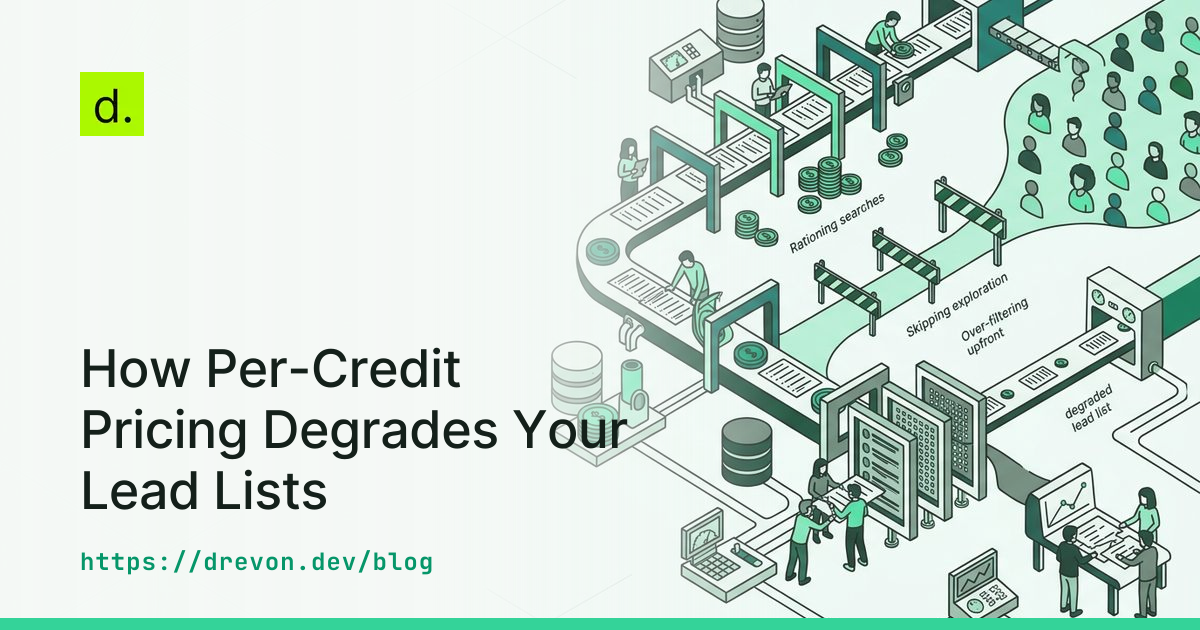
Most growth tools price by the unit. One credit reveals one email, exports one company, or unlocks one phone number. This model is common because it seems to align cost with usage, but it has a potent, unstated effect on user behavior: it creates a scarcity mindset.
When a resource is finite and metered, the user’s primary goal shifts from solving a problem to conserving the resource. The work of building a lead list is no longer about exploration and discovery; it becomes an exercise in avoiding waste. This is a form of premature optimization. Users are incentivized to construct the 'perfect' search on the first try, applying rigid filters based on a hypothesis of their ideal customer before they have data to validate it.
This behavior is rooted in fundamental cognitive biases. As economists Daniel Kahneman and Amos Tversky established, the psychological pain of a loss is roughly twice as powerful as the pleasure of an equivalent gain. Wasting a credit feels like a tangible loss, which triggers this loss aversion. Product management experts call the resulting behavior 'consumption anxiety,' where users avoid high-impact workflows to preserve their credit balance.

The Second-Order Effects on List Quality
This forced precision has second-order effects that degrade the final lead list. Over-filtering means users miss high-potential leads that fall just outside their narrow criteria. A target with the title 'Head of Revenue Operations' might be missed by a search for 'VP of Sales,' even if their role is functionally identical.
More importantly, the credit model punishes iteration. As GTM leaders from organizations like Reforge and First Round Review consistently argue, the best go-to-market strategies emerge from a process of discovery. You start with a hypothesis, run queries, analyze the results, and refine your parameters. This iterative loop is essential for moving from an assumed ICP to one validated by the market. But when each query costs credits, this process becomes prohibitively expensive.
For example, running 'negative space' searches to see what *doesn't* work is a powerful way to refine an ICP, but it is an unjustifiable use of credits in a metered system. The result is a smaller, less diverse list that merely confirms existing biases rather than uncovering new market opportunities.

Why We Chose a Different Model
We designed our model to encourage exploration. Our goal is to have users run ten or twenty queries to build one excellent list, because that is how the best work is done. This aligns our business model with the user's actual goal: the quality of the final result, not the quantity of actions taken to get there.
This decision has a direct and significant cost for us. An exploratory search process that involves an AI agent browsing multiple live sources, analyzing unstructured text, and synthesizing findings is more computationally expensive than a simple, indexed database lookup. A database lookup is a highly optimized, low-cost operation that retrieves a static record in milliseconds. Our process involves higher CPU, memory, and I/O costs to perform novel analysis for every query. We accept this trade-off because the superior outcome for the user—a more accurate and effective GTM motion—makes our product fundamentally more valuable.

Evaluate Your Tools
A pricing model is a core product feature. It dictates how you can and cannot use a tool, and it shapes the quality of your work. When evaluating any growth tool, look past the feature list and consider the incentives created by its business model. Ask whether it encourages or punishes the experimentation required to find your next customers. The goal is to grow a business, not to conserve credits.